
How to Rank in AI Search (GEO): The Best Complete 2026 Guide
The Wake Up Call
Your blog ranks #1 on Google.
But nobody sees it.
Why? Because people stopped clicking on Google. They search ChatGPT instead. And when ChatGPT generates an answer to their question, your #1 ranked article isn’t anywhere in that answer
This is happening right now in 2026.
The overlap between top Google links and AI-cited sources has dropped from 70% to below
Translation: Getting to page 1 of Google is no longer enough.
You need to get INSIDE the AI answer itself.
That’s what GEO is.
What’s Happening Right Now (The Situation)
Traditional SEO click-through rates are declining as AI systems answer queries directly. GEO is becoming as important as SEO was in the early 2010
Think about it:
Old way (2015): You Google “best laptops for programming” → Click 8 websites → Read reviews → Compare specs → Come back to Google → Click again → Finally decide
New way (2026): You ask ChatGPT “best laptops for programming” → ChatGPT reads 20 websites → Generates one answer → Cites 3-4 sources inside that answer → You read. Done.
If your website isn’t one of those 3-4 cited sources, you got zero clicks.
Even if you rank #1 on Google.
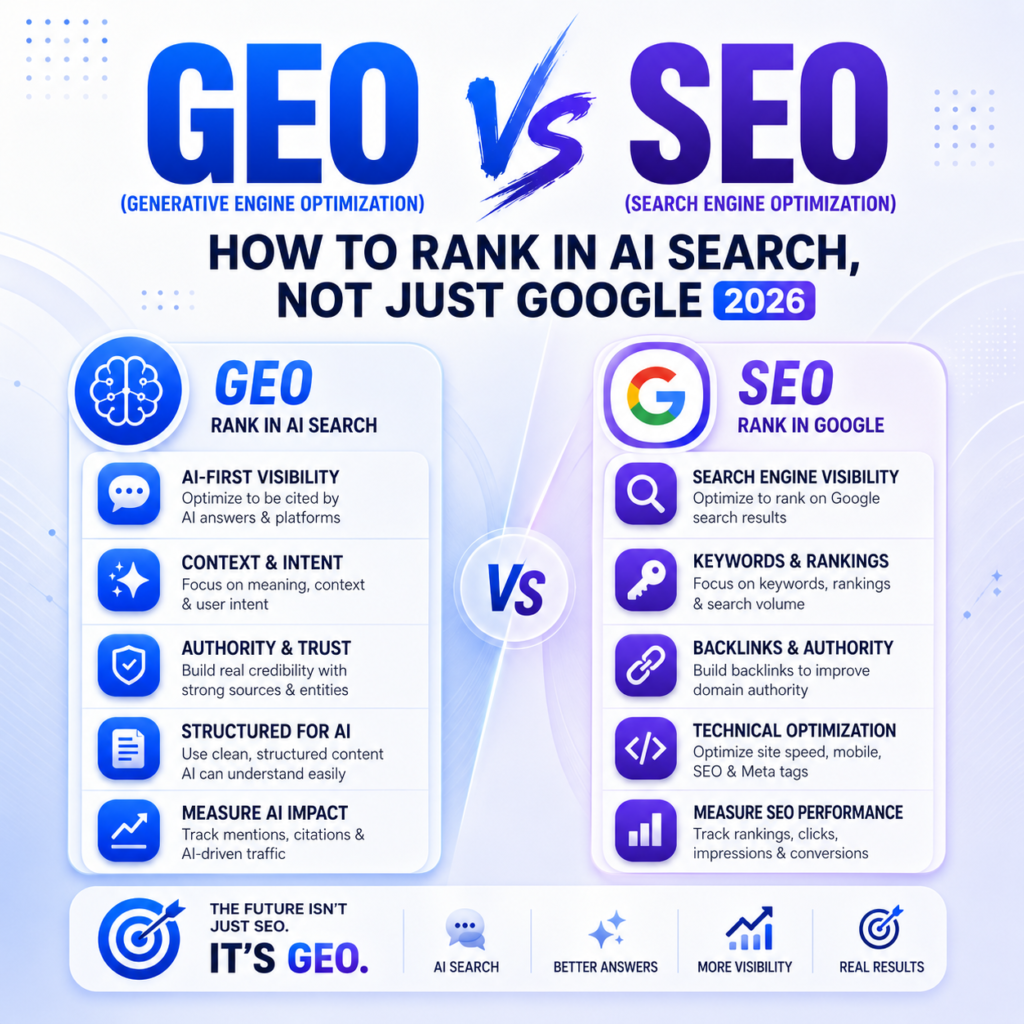
GEO vs SEO: The Critical Difference
SEO (Traditional)
- Goal: Rank on Google’s list of blue links
- Metric: Position (1st, 2nd, 3rd page)
- User journey: See your link → Click → Read your site
- Tools: Google Search Console, backlinks, keywords
GEO (New)
- Goal: Get cited INSIDE AI-generated answers
- Metric: Citation frequency (how often AI mentions you)
- User journey: User asks AI → AI cites your content → User reads answer (may not click)
- Tools: Different approach entirely
The Critical Truth
Ranking on page one of Google does not guarantee you will appear in AI answers. And appearing in AI answers does not require ranking on page one
Your entire SEO strategy might be worthless for GEO.
You need both. But they’re different games.
How AI Actually Decides What To Cite (The Tech)
When someone asks an AI a complex question, the AI breaks it into smaller sub-queries and searches for each one separately. If someone asks “What is the best VPN for streaming Netflix in Europe?” the AI might search for “best VPN 2026,” “VPN Netflix streaming,” and “VPN Europe servers” as three separate queries
Why it matters for you:
If you write one big article on “Best VPNs 2026,” the AI breaks that question into parts:
- What makes a good VPN?
- Best for Netflix specifically
- Speed/servers in Europe
- Pricing
If your article covers all 4 parts? You get cited 4 times (or more).
If your article only covers 1 part? Cited once (or not at all).
The 5 Practical Strategies That Actually Work (2026 Tested)
Strategy #1: Answer First Content Structure
This is the #1 difference between content AI cites and content it ignores.
Wrong way: “There are many factors to consider when choosing an AI tool. Let me explain the history of AI tools first, then talk about the market trends, and finally discuss which tools work best…”
(AI skips this. Too much fluff.)
Right way: “The best AI tools for content writing in 2026 are: ChatGPT (best for speed), Claude (best for accuracy), and Jasper (best for templates).”
Then expand.
AI systems evaluate a page’s relevance primarily on its opening content. The first 200 words of any article should directly and completely answer the primary query not build up to the answe
Practical tip: Your first sentence should answer the question completely. Then spend the rest of the article explaining why.
Strategy #2: Data-Dense Writing With Actual Statistics
AI models prioritize content that contains verifiable facts, statistics, and data. Aim to include a relevant statistic or data point every 150–200 words
If you cite actual statistics, AI feels safer citing you.
Wrong way: “Many people use ChatGPT for their work. It’s very popular and trusted.”
(No stats = AI won’t cite it)
Right way: “ChatGPT reached 900 million weekly active users by early 2026 (OpenAI, 2026), making it the 5th most visited website globally (similar data). 49% of ChatGPT users ask it informational questions, while 40% ask it to create things (Profound, 2026).”
(Stats + citations = AI will cite this)
Strategy #3: FAQ Sections (Underrated Goldmine)
FAQ sections are one of the highest-value GEO investments because they directly match how users phrase queries to AI tools
Think about it: When you ask ChatGPT a question, it’s phrased naturally: “What’s the cheapest AI tool for content writing?” or “Can I use free AI tools professionally?”
These are FAQ questions.
Strategy: Create a 10-15 question FAQ at the end of every article.
Use questions people actually ask (check Reddit, Twitter, Google searches).
Mark them with FAQ schema. (Tells AI engines where your Q&A is.)
Strategy #4: Build E-E-A-T Like Your Life Depends On It
(Experience, Expertise, Authoritativeness, Trustworthiness) is the core trust framework AI engines use to evaluate sources
Experience: Have you actually done this? Or are you repeating what others said?
Expertise: Do you know your subject? Can you teach someone?
Authoritativeness: Does the industry respect you? Are you cited by other experts?
Trustworthiness: Are you honest about limitations? Do you cite sources?
Practical:
- Write bios mentioning your actual experience
- Cite other experts
- Admit what you DON’T know
- Use real examples from your work
- Get mentioned on third-party sites (this builds authority)
Strategy #5: Third-Party Validation (The Real Authority Play)
Getting your brand mentioned on third-party sites that AI models trust is one of the most effective GEO moves available. That means earning coverage in industry publications, getting listed in relevant directories, and generating reviews on platforms like Google, Yelp, and Trustpilot
This is huge.
AI doesn’t just look at what you say about yourself. It looks at what OTHERS say about you.
Practical: Get mentioned on:
- Industry publications
- Relevant directories
- Review sites (Google, Trustpilot)
- Reddit communities (answer questions, get upvotes)
- YouTube (tutorials, mentions)
- Podcast guest appearances
Each mention = authority signal for AI.
What Does NOT Work (Google Confirmed This In June 2026)
There’s a lot of bad GEO advice floating around.
You don’t need: llms.txt files, special markup, content chunking into micro-pieces, or secret schema. Google’s systems handle nuance across a full page and surface the relevant part on their own risk
Don’t waste time on:
❌ Creating an llms.txt file
❌ Chunking content into tiny fragments
❌ Special “GEO optimized” schema markup
❌ Keyword stuffing (even “for AI”)
❌ Writing content specifically “for AI” (it sounds robotic)
Real Implementation Plan (What To Actually Do)
Week 1: Audit Your Current Content
Check your top 10 blog posts:
- Do they answer the question in the first 200 words? (If no, rewrite the intro)
- Do they have statistics? (If no, add 3-5 verified stats)
- Do they have an FAQ section? (If no, add 10-15 questions)
- Do they mention your experience? (If no, add personal examples)
Week 2-3: Rewrite/Update Top Performing Posts
Take your most-read posts. Update them with:
- Answer-first structure
- Current 2026 data
- FAQ sections with schema markup
- Better E-E-A-T signals
- Third-party citations
Week 4: New Content With GEO In Mind
Write new posts using the GEO framework:
- Direct answer in first 150 words
- Data point every 150-200 words
- FAQ section at end
- E-E-A-T signals throughout
Ongoing: Track AI Mentions
You can’t improve what you don’t measure.
Manually test how often your brand/website appears in:
- ChatGPT responses
- Perplexity answers
- Google AI Overviews
- Gemini responses
Ask your specific questions on each platform. See if you’re cited.
Real Example (How This Works)
Before GEO Optimization
Your blog: “The 10 Best AI Tools for 2026”
- Ranks #3 on Google (good position)
- Gets 500 clicks/month
- Gets cited in AI answers: 0 times
ChatGPT answer to “Best AI tool for writing”: Cites: Medium article, ProductHunt review, Reddit thread
Your site isn’t there.
After GEO Optimization
Your blog: Same article, but rewritten for GEO
- Ranks #5 on Google (dropped in ranking)
- Gets 200 clicks from Google (fewer clicks)
- Gets cited in AI answers: 47 times/month
- Gets 300+ clicks from AI referrals
- Converts better (AI visitors are higher intent)
FAQ Section
Q: Does GEO replace SEO?
A: No. SEO is still critical. <cite index=”35-1″>Brands that excel at GEO are typically the same brands with strong traditional SEO foundations</cite>. Do both.
Q: How long before I get cited in AI answers?
A: Depends on your current authority. If you already rank well on Google: 2-4 weeks. If you’re new: 2-3 months.
Q: Will I lose Google traffic if I optimize for GEO?
A: Maybe. Your Google ranking might drop slightly (you’re optimizing for different signals). But AI traffic makes up for it.
Q: Which AI platforms should I focus on?
A: In order of importance: ChatGPT (900M users), Google AI Overviews (50% of queries), Perplexity, Gemini.
Q: Can I use AI to write GEO-optimized content?
A: Yes, but be careful. AI-written content often sounds robotic. Write it yourself, then use AI to edit. Make it sound human.
Q: Should I rewrite all my old posts?
A: Start with your top 20 traffic-getting posts. Those have the most impact.
Q: Do I need technical changes to my website?
A: Just check that robots.txt and Cloudflare aren’t blocking AI bots. No special schema needed.