

AI Agents vs AI Tools Which is Best in 2026?
The Lightbulb Moment
Last week I watched someone waste 3 hours.
They were using ChatGPT to manage customer support emails. Every email came in. They copied it into ChatGPT. ChatGPT wrote a response. They sent it manually.
50 emails. 3 hours.
When I said “You need an AI agent,” they said: “Isn’t that the same thing?”
No. It’s not even close.
The difference between an AI tool and an AI agent is the difference between having an assistant who tells you what to say, and an assistant who just handles it completely.
The Simple Definition
AI Tools: “Tell Me What To Do”
AI tools tell you what to do. They provide analysis, suggestions, predictions, or outputs based on your input. You interpret the results and then act on them.
Examples:
- ChatGPT (writes text, you decide what to do with it)
- Grammarly (checks grammar, you decide whether to fix it)
- Canva (generates graphics, you choose which one)
- Google Analytics (shows data, you decide what to change)
How it works:
You → Input → AI Tool → Output → You (take action)😄
You’re still doing the work. The tool just helps you think faster.
AI Agents: “Just Handle It For Me”
AI agents can perceive, decide, and take actions on behalf of the user, often in a loop, with some autonomy
Examples:
- Zapier Agent (watches your inbox, answers customer emails automatically)
- Lindy (joins meetings, takes notes, sends summaries without you)
- Make (processes invoices automatically from start to finish)
- n8n (monitors data, makes decisions, executes workflows)
How it works:
You (set goal) → AI Agent → Takes Actions Automatically → Done (you verify)✔
You’re not doing the work anymore. You’re directing the work.

The Real-World Difference (Why It Actually Matters)
Scenario: Managing Customer Support Emails
Using AI Tools (The Hard Way)
Day 1:
- Email arrives: “Can you help me track my order?”
- You paste it into ChatGPT
- ChatGPT suggests an answer
- You edit it
- You send it manually
- Time: 4 minutes per email
50 emails = 3.3 hours of YOUR time
Using AI Agents (The Smart Way)
Day 1:
- 50 emails arrive
- Agent reads all of them
- Agent checks knowledge base for answers
- Agent writes personalized responses automatically
- Agent sends them all
- You review 5 minutes of summaries
50 emails = 5 minutes of YOUR time
The difference? 3.25 hours saved. Every single day.
That’s 16+ hours a week. 66 hours a month. 790 hours a year.
In money terms: If you’re worth $50/hour, that’s $39,500/year in time saved.
With an AI tool? You got faster at thinking. With an agent? You got freedom.
The 5 Key Differences (Detailed)
Difference #1: Autonomy
AI Tools: Reactive only. They wait for you to ask.
You have to:
- Think of the question
- Input the question
- Get the answer
- Decide what to do
- Take action
AI Agents:Proactive and autonomous. They act independently using machine learning and natural language processing to make decisions based on evolving goals and data—not just instructions passed to them.
They:
- Watch for situations that need attention
- Decide what action is needed
- Take that action automatically
- Report back what they did
Example:
Tool: You remember at 3 PM to check if anyone replied to yesterday’s customer inquiry. You search emails. You read reply. You respond.
Agent: Agent monitors inbox 24/7. Someone replies at 2 AM. Agent reads it, checks your FAQ, writes appropriate response, sends it. You see summary in morning.
Difference #2: Time Investment
AI Tools: Require constant human input.
Every task → You think → You input → Tool responds → You act
Repeat 50 times a day.
AI Agents: Set once, run forever (with occasional checks).
You configure agent once. It runs for months. You check results weekly.
Time math:
Tool: 4 min/task × 50 tasks = 3.3 hours/day
Agent: 2 hours setup + 10 min/day checks = 2 hours once, then 10 min/day forever
Difference #3: Decision Making
AI Tools: Can’t actually decide anything.
ChatGPT can’t decide “should I send this email?” It can only suggest.
You decide.
AI Agents:Make decisions based on evolving goals and data
Agent can decide: “This is a routine FAQ question → Answer with FAQ response → Send immediately. This is a complex issue → Escalate to human.”
No human needed for the routine stuff.
Difference #4: Scalability
AI Tools: Scale only if you have more people.
50 emails? Takes you 3 hours. 500 emails? Takes you 30 hours. 5,000 emails? You need to hire someone.
AI Agents: Scale automatically.
50 emails? Agent handles in 2 minutes. 500 emails? Agent handles in 15 minutes. 5,000 emails? Agent handles in 2 hours.
Same agent. Same cost. Unlimited scale.
Difference #5: Learning & Improvement
AI Tools: Same performance every time.
ChatGPT gives you the same quality answer today as it did last year.
AI Agents: Can improve over time.
AI agents learn from new data to improve their decision-making over time
Agent sees what worked. Sees what didn’t. Adjusts behavior.
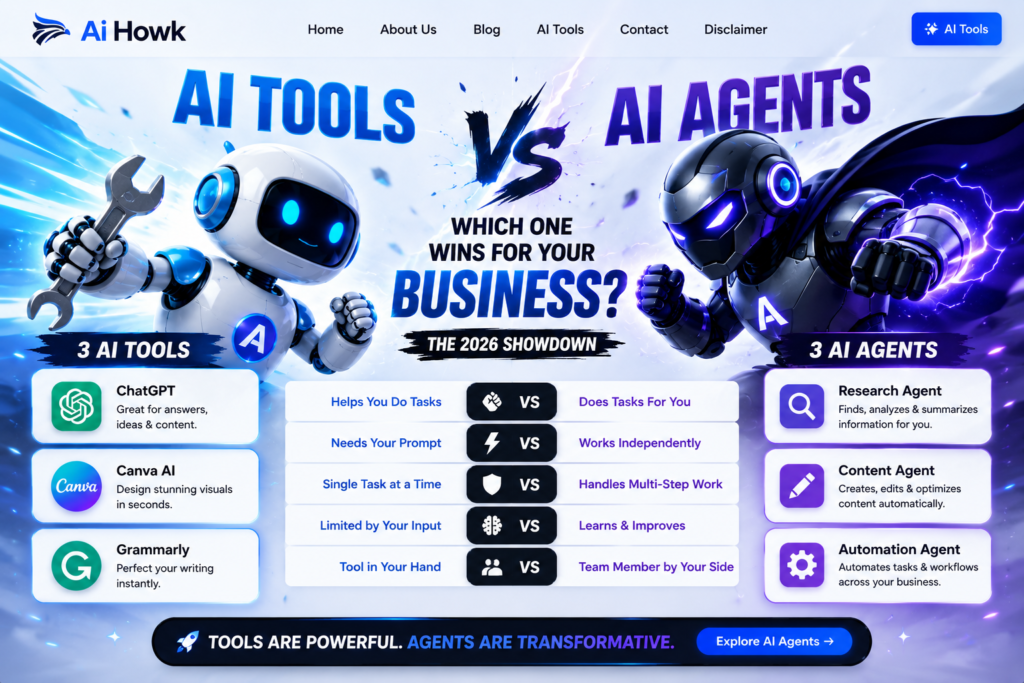
Quick Comparison Table
| Aspect | AI Tools | AI Agents |
|---|---|---|
| You ask | React | Proactive |
| Decides | You | Agent |
| Takes action | You | Agent |
| Time per task | 4-10 min | 0 min (automatic) |
| Scales by | Hiring people | Just runs |
| Setup time | 2 minutes | 2-4 hours |
| Ongoing work | Constant | Minimal |
| Works while you sleep | ❌ | ✅ |
When To Use AI Tools (They’re Still Good For Some Things)
Tools are better when:
✅ You need creative output — ChatGPT writing blog posts (you edit and publish)
✅ You need analysis you’ll act on — Analytics tool showing trends (you decide next steps)
✅ Task is one-time — Canva creating a one-off graphic
✅ You need suggestions — Grammarly suggesting tone fixes (you approve them)
✅ Speed matters more than setup — Need answer in 30 seconds
Real example: Using ChatGPT to brainstorm 10 article ideas for your blog. Takes 3 minutes. You choose the best 3. Worth it.
When To Use AI Agents (The Game Changer)
Agents are better when:
✅ Same task repeats — Emails, invoices, leads, support tickets (it happens every day)
✅ Speed is critical — Customer needs response in minutes, not hours
✅ Volume is high — 50+ items daily (agents scale, people don’t)
✅ Decision is simple — “Answer FAQs, escalate complex issues” (not ambiguous)
✅ You want your time back — Less time on busywork, more on strategy
Real example: A project management AI agent that reassigns resources based on shifting timelines or real-time progress, supporting complex goal-driven operations It watches, decides, acts. You just check the summary.
Real Money Impact
Scenario: Small Business With 100 Customer Emails/Day
Using Tools Only:
- Support person: $40,000/year salary
- Processes 100 emails/day manually
- Response time: 4 hours
- Customer satisfaction: Medium (slow response)
Using Agents:
- No support person needed
- Agent processes 100 emails/day automatically
- Response time: 2 minutes
- Customer satisfaction: High (fast response)
- Cost: $300/month ($3,600/year) for agent platform
Savings: $36,400/year
Plus: Higher customer satisfaction. Fewer support complaints. More revenue.
Actionable Steps (Start This Week)
If You’re Using AI Tools Only:
Step 1 (Today): List your top 3 repetitive tasks (email answering, data entry, report generation)
Step 2 (Tomorrow): For each task, ask: “Does this happen more than 5 times per day?”
If YES → You need an agent.
Step 3 (This Week): Sign up for Zapier ($0 free tier) or Make.com ($0 free tier)
Step 4 (This Week): Build ONE simple automation with an agent
Example: “When customer fills form, add to spreadsheet, send welcome email”
Step 5 (Week 2): Measure: How much time did it save?
Common Questions
Q: Are agents more expensive than tools?
A: Agents cost $10-100/month. Saving one person 10 hours/week is worth way more. ROI: 10-50x.
Q: Can I start with tools and upgrade to agents later?
A: Yes. Start with tools for brainstorming/analysis. Move to agents when you have repetitive work.
Q: What if the agent makes mistakes?
A: It will. Most agents are 85-95% accurate. You still save 80% of your time reviewing vs doing it all.
Q: Is this replacing my job?
A: No. You’re replacing busywork. You’ll have time for: strategy, customer relationships, business growth. Better work.
Q: Which agent platform do I choose?
A: Start with Zapier for simplicity. Move to Make for complexity. Use Lindy for “set and forget.”