
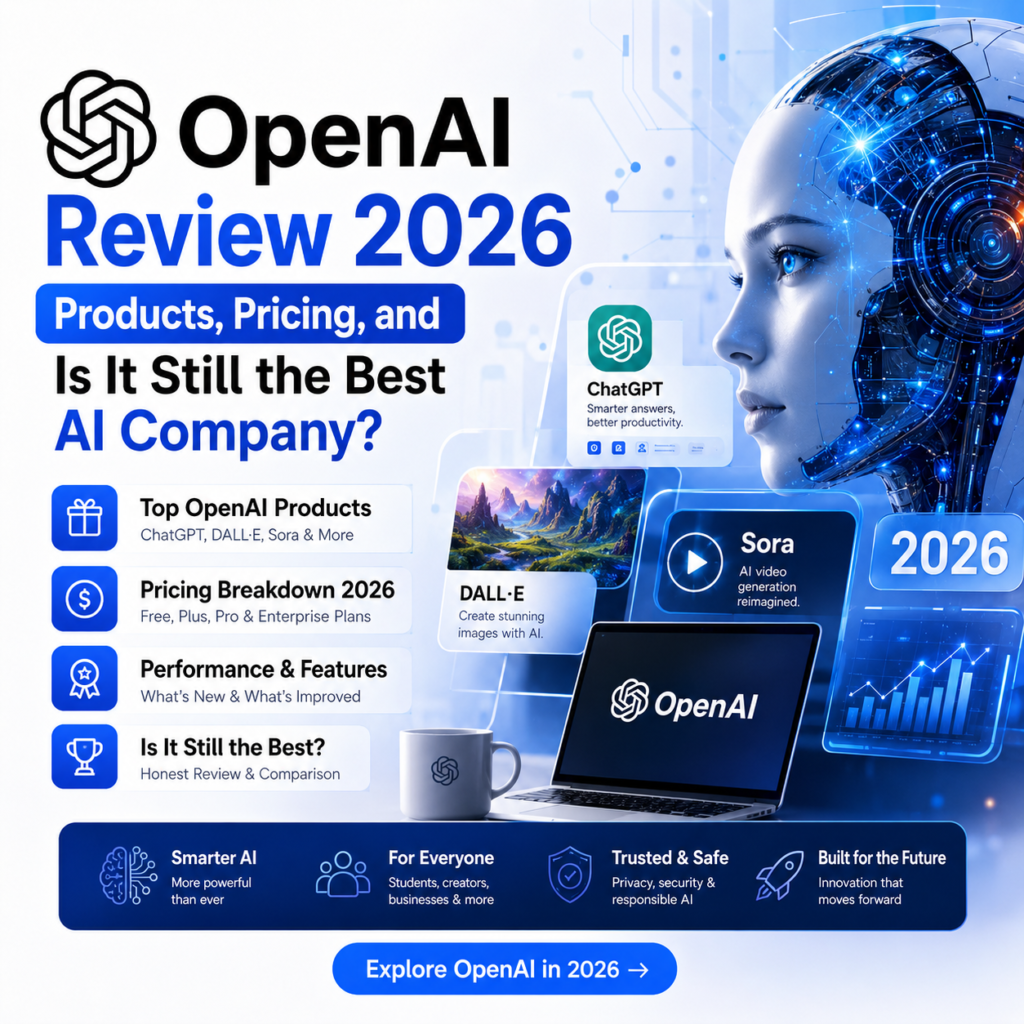
OpenAI Review 2026: Products, Pricing, and Is It Still the Best AI Company?
A few years ago, OpenAI was the obvious answer to almost every AI question. ChatGPT launched and nothing was the same. The company went from a research lab most people had never heard of to the most discussed technology company on the planet in about twelve months.✅
In 2026, the answer is more complicated. OpenAI is still the largest, most widely used AI platform in the world and over five million people use Codex every week, and ChatGPT’s user base is counted in the hundreds of millions. But Anthropic’s Claude has taken benchmark leads in reasoning and coding. Google’s Gemini has closed the gap in search and research. The era when OpenAI was simply the best at everything is over.
I personally say a lot of time That does not make OpenAI a bad choice. It makes the decision more interesting. Here is an honest assessment of where the company stands in 2026, what its products actually do, and who should and should not be paying for them.
The OpenAI Product Lineup in 2026
OpenAI offers more distinct products than any other AI company right now. Understanding what each one does prevents you from paying for things you do not need.
ChatGPT is the consumer product. It handles conversation, writing, analysis, image generation, voice interaction, and code. The free tier uses GPT-4o mini. Plus at $20/month (approx. PKR 5,600/month) gives access to GPT-5.4, the current standard model. Pro at $200/month (approx. PKR 56,000/month) adds the most powerful models, Operator browser control, and Deep Research.
Codex is OpenAI’s coding agent. It runs as a cloud service, a CLI tool, an IDE extension inside VS Code, and a ChatGPT app. It is powered by GPT-5.5, which scores 83.4% on Terminal-Bench 2.1 the leading benchmark for coding agents. Over five million developers use it weekly.
Operator is the browser automation agent, now unified with ChatGPT and Deep Research into a single agentic system for Pro subscribers. It controls a browser to complete web tasks or forms, booking, research across multiple sites. The benchmark performance is lower than competitors, but no other tool replicates its specific web-automation workflow within a consumer product.
Sora is OpenAI’s video generation model. It was one of the most anticipated AI products of 2025, and the reception since release has been mixed. The quality for short creative clips is impressive; consistency across longer videos remains a work in progress.
The API gives developers access to the full model lineup and GPT-5.5, GPT-5.4, GPT-4.1, o3, DALL-E, Whisper, and real-time voice or under a single platform. It is the largest and most mature AI developer platform available, with more tutorials, libraries, and third-party integrations than any competitor.
Pricing Breakdown
ChatGPT Free: Basic conversational AI, GPT-4o mini, daily access limits. ChatGPT Plus: $20/month (approx. PKR 5,600/month). GPT-5.4, image generation, voice mode. ChatGPT Pro: $200/month (approx. PKR 56,000/month). GPT-5.5, Operator, Deep Research, priority access. ChatGPT Team: $25/seat/month (approx. PKR 7,000/seat/month). Shared workspace, admin tools. ChatGPT Enterprise: Custom pricing. Full security controls, compliance, dedicated onboarding.
The pricing jump from Plus to Pro — $20 to $200, a ten-times increase — is the most discussed decision in OpenAI’s consumer lineup. For most users, Plus handles 90% of practical needs. Pro makes sense for heavy users who rely on Deep Research, Operator, or need the most capable model for demanding professional work.
What OpenAI Does Better Than Anyone Else
Breadth is the honest answer. No single AI platform covers text generation, image creation, video generation, speech-to-text, text-to-speech, embeddings, fine-tuning, coding agents, browser automation, and real-time voice under one API and one subscription. OpenAI does all of this. Anthropic does primarily text. Google’s developer platform is strong on text and image but does not match the breadth.
The ecosystem is the other genuine advantage. ChatGPT has the most Custom GPTs, third-party integrations, and community knowledge of any AI platform. If you need to connect AI to a specific tool or workflow and someone has already built an integration, it is most likely built for ChatGPT.
For developers, the API stability and documentation quality have been consistent. OpenAI’s SDK is the most widely used in production AI applications globally.
Where OpenAI Falls Short
Reasoning quality is the honest gap. Claude Opus 4.7 and 4.8 outperform OpenAI’s best models on hard reasoning tasks, complex coding problems, and long-context document analysis. For users where the output quality of long-form writing or difficult analysis matters most, Anthropic has taken the technical lead.
Operator’s performance at 32.6% on OSWorld is the most significant gap in the product lineup. At $200/month for Pro access, users expecting reliable browser automation encounter a tool that fails more than it succeeds on standardized testing.
Price-to-value at the Pro tier is a genuine question. $200/month (approx. PKR 56,000/month) is more than double Anthropic’s top consumer plan and four times Google AI Pro. The capability gap no longer justifies a price gap of that magnitude for most users.
SMB pricing for OpenAI has also increased sharply — up 140% year-over-year according to spend data from enterprise software tracking services. Finance teams inside organizations are scrutinizing whether the per-seat cost justifies the value.
Is OpenAI Still Worth It in 2026?
For most individual users — yes, at the Plus tier. $20/month (approx. PKR 5,600/month) for GPT-5.4 access, image generation, voice mode, and file uploads is competitive with every other major AI subscription at the same price point. The free tier is also meaningfully improved and handles casual use well.
For the Pro tier at $200/month — it depends. If you use Deep Research heavily, need Operator for specific browser workflows, and want the most powerful model for demanding professional work, the price can be justified. If you are on Plus and considering upgrading, the marginal improvement over Plus needs to be measured against a $180/month (approx. PKR 50,400/month) difference.
For developers — OpenAI’s API remains the safest default for production applications that need breadth across modalities. If your application needs text, images, speech, and embeddings from one provider, nothing else comes close.
For pure text quality and reasoning — Claude Pro at $20/month (approx. PKR 5,600/month) is the more honest recommendation. Anthropic has taken the benchmark lead in the capabilities that matter most for writing, analysis, and coding.
Quick Verdict
OpenAI in 2026 is no longer the unambiguous leader it was two years ago. It is the largest, most versatile, and most ecosystem-rich AI platform — which is a genuine and significant advantage for certain use cases. But it is no longer the best at any single core AI capability, and the pricing at the Pro tier requires a specific justification that not every user will find convincing.
The honest position: start with ChatGPT Plus if you want a single all-in-one AI subscription. Compare it with Claude Pro for one month. Then keep whichever one you actually use.
FAQ SECTION
Q: Is ChatGPT still the best AI in 2026? A: ChatGPT is still the most widely used and most versatile AI assistant available. But Anthropic’s Claude has taken the quality lead on writing and reasoning benchmarks, and Google’s Gemini has closed the gap on research. ChatGPT is no longer the best at any single capability — it is the best all-around option for users who want one tool that handles everything reasonably well.
Q: What is the difference between ChatGPT Plus and Pro in 2026? A: Plus at $20/month (approx. PKR 5,600/month) gives access to GPT-5.4, image generation, voice mode, and file uploads. Pro at $200/month (approx. PKR 56,000/month) adds GPT-5.5, Operator browser control, Deep Research, and priority access. For most users, Plus covers practical daily needs. Pro is designed for heavy professional use where those specific features justify the price.
Q: How does OpenAI compare to Anthropic in 2026? A: OpenAI wins on breadth — more modalities, more integrations, larger ecosystem. Anthropic wins on reasoning and writing quality — Claude Opus 4.7 and 4.8 lead the most challenging benchmarks. Both cost $20/month at the standard tier. OpenAI’s Pro tier at $200/month has no direct Anthropic equivalent at that price.
Q: Is OpenAI API good for developers in 2026? A: Yes — it remains the most complete developer platform for AI, covering text, images, audio, video, embeddings, fine-tuning, and real-time voice under one API. The documentation quality and SDK ecosystem are the strongest in the industry. For pure reasoning quality, Anthropic’s API is preferred by some developers, but OpenAI covers more use cases from a single integration.
Q: What happened to DALL-E 3 in 2026? A: OpenAI retired DALL-E 3 and replaced it with GPT Image 2 (marketed as ChatGPT Images 2.0) in mid-2026. GPT Image 2 scores significantly higher on image quality benchmarks and handles text inside images considerably better than DALL-E 3 did.
Q: What is OpenAI Codex in 2026? A: Codex is OpenAI’s coding agent, available as a CLI tool, cloud service, IDE extension, and ChatGPT app. Powered by GPT-5.5, it scores 83.4% on Terminal-Bench 2.1, making it one of the two leading coding agents alongside Claude Code. Over five million developers use it weekly.